




From Strategy to Systems: AU IPED Supports Burundi’s Next Step in Strengthening Education Data
From Strategy to Systems: AU IPED Supports Burundi’s Next Step in Strengthening Education Data
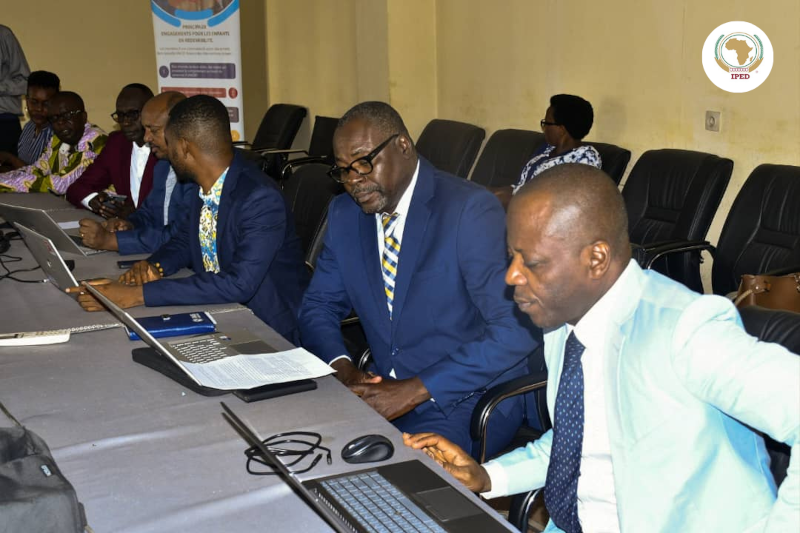
Bujumbura, Burundi, 9 June 2026 – The African Union Commission, through its Pan-African Institute for Education for Development (AU-IPED), has joined the Government of Burundi in Bujumbura for a three-day technical workshop aimed at strengthening the country’s Education Management Information System (EMIS) through a self-assessment guided by the African Union EMIS Norms and Standards.
The workshop will be convened from the 9th to 11th June 2026 under the theme, “State of Burundi’s EMIS: Self-assessment using AU EMIS Norms and Standards.” It brings together representatives of the Ministry of Education, AU-IPED, national technical teams, and relevant education partners to examine the current state of Burundi’s education data system, identify areas for improvement, and agree on priorities that can support the country’s transition from strategy to implementation.
The AU EMIS Norms and Standards provide a continental reference framework to help Member States strengthen the quality, coherence, comparability, and use of education data. By applying this framework, Burundi is positioning its EMIS as more than an administrative reporting tool, but as a strategic instrument for planning, accountability, and evidence-informed education reform.
Speaking at the opening of the workshop, Mr. Adoumtar Noubatour, Coordinator of AU-IPED, noted that the mission comes at an important moment for Burundi’s education sector, where fragmented and outdated data can limit effective planning and decision-making. He emphasized that strengthening EMIS requires attention not only to digital tools, but also to the institutional, technical, and human capacities that allow education data to be collected, harmonized, analyzed, and used.
Mr. Noubatour further highlighted the value of learning from successful information systems in other sectors, particularly health, where digital platforms have supported more integrated and timely data management. In this regard, the workshop includes a technical session on District Health Information Software 2 (DHIS2), an open-source digital platform widely used for data collection, management, analysis, and reporting. The session is supported by experts from the University of Oslo-HISP West and Central Africa, with further experience-sharing on the use of DHIS2 in Togo.
According to Mr. Gashirahiamwe Cassier, Head of Action, Planning, Programming, Monitoring and Evaluation at the Ministry of Education, the workshop is particularly timely, taking place in the context of the validation of Burundi’s EMIS strategy and the intention of the GPE KIX Africa 21 (KIX21) country team to forward the workshop recommendations to the KIX21/Francophone coordination for possible funding consideration.
The discussions in Bujumbura are aligned with the African Union’s broader education and development agenda, including the Continental Education Strategy for Africa 2026–2035 (CESA 26–35) and Agenda 2063, both of which call for stronger systems, better evidence, and improved capacity to deliver inclusive and quality education across the continent.
Over the three days, participants will undertake a self-assessment of Burundi’s EMIS against the AU EMIS Norms and Standards, review the potential of digital solutions, identify priority areas for action, and formulate recommendations to guide the next phase of EMIS strengthening in Burundi.
The African Union, through AU-IPED, remains committed to supporting Burundi and other Member States in building robust, harmonized, and sustainable education data systems that strengthen governance, improve planning, and contribute to better education outcomes for all learners.
-
Share:


