



POLICY BRIEF: Strengthening Mozambique's Education Data System
POLICY BRIEF: Strengthening Mozambique's Education Data System
Findings and Recommendations from the KIX Africa Hub 19 National Policy Dialogue
Maputo, Mozambique, 3 to 7 August 2026
Policy brief prepared by AU-IPED, on behalf of the KIX Africa Hub 19 consortium (AU-IPED, UNESCO-IICBA and UNICEF ESARO), in collaboration with the Ministry of Education and Culture of Mozambique
Executive Summary
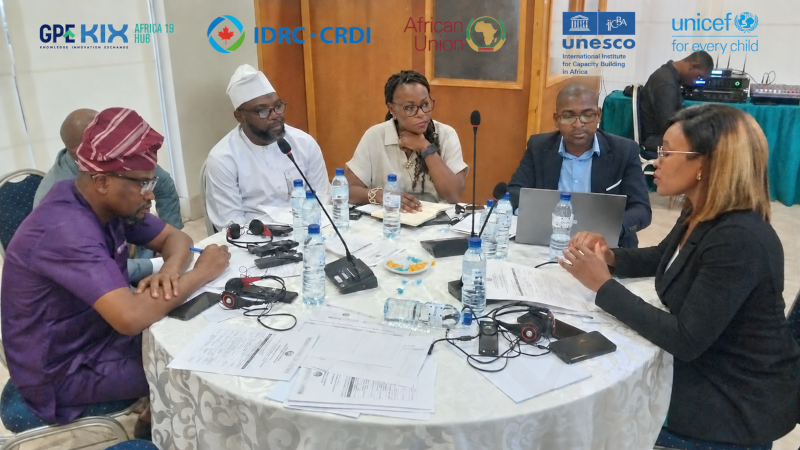
From 3 to 7 August 2026, the African Union Pan-African Institute of Education for Development (AU-IPED) and the Ministry of Education and Culture (MEC) of Mozambique convened the KIX Africa Hub 19 National Policy Dialogue in Maputo. AU-IPED forms the GPEKIX Africa 19 Hub in consortium with UNESCO's International Institute for Capacity Building in Africa (UNESCO-IICBA) and UNICEF's Eastern and Southern Africa Regional Office (UNICEF ESARO). The Dialogue was held with the support of the Global Partnership for Education’s Knowledge and Innovation Exchange (GPE-KIX), delivered jointly with Canada’s International Development Research Centre. The Dialogue brought together approximately 50 representatives of government, higher education institutions, researchers and development partners, including UNESCO and UNICEF, around four national priorities: the professional development of teachers, equity and inclusion, early childhood education, and the strengthening of education data systems.
Ahead of the Dialogue, a joint AU-IPED and Ministry team carried out a field assessment of Mozambique's Education Management Information System (EMIS), reaching the Ministry, provincial and district education services, and schools in Maputo City and Maputo Province. This brief summarises what that assessment found and sets out a three-year, costed programme of recommendations, estimated at USD 3,003,000, to close the gaps identified. It also places this work within the wider agenda of the Continental Education Strategy for Africa 2026-2035 (CESA 26-35) and the mandate of KIX Africa Hub 19.
Context
Countries in Sub-Saharan Africa continue to face serious challenges in delivering inclusive, equitable and quality education, as set out in Sustainable Development Goal 4 and the Continental Education Strategy for Africa (CESA 26-35). More than 98 million school-age children and young people in the region are out of school, the largest number of any region globally (UNESCO Institute for Statistics). Approximately 9 in 10 children aged 10 cannot read and understand a simple text, a measure of learning poverty (World Bank). Girls face additional barriers to accessing, remaining in and completing school, linked to early marriage, adolescent pregnancy and restrictive social norms (UNICEF). Teacher training remains inconsistent, classrooms are often overcrowded, and teaching materials are in short supply (GPE, UNESCO). Fewer than 30 percent of children in the region have access to pre-primary education, despite its established importance for cognitive development (UNESCO).
These challenges are compounded by poverty, conflict, displacement and the lasting effects of the COVID-19 pandemic. Addressing them requires systems that can produce timely, accurate and usable data: without a functioning education data system, policy in each of these areas is made with limited visibility into where problems are most acute and whether reforms are working.
The National Dialogue and the EMIS Field Assessment
GPE-KIX, is delivered jointly by the Global Partnership for Education (GPE) and the International Development Research Centre (IDRC) to support knowledge sharing, innovation and collaborative learning among partner countries. It is carried into national systems through regional hubs such as KIX Africa Hub 19, formed by a consortium of AU-IPED, UNESCO's International Institute for Capacity Building in Africa (UNESCO-IICBA) and UNICEF's Eastern and Southern Africa Regional Office (UNICEF ESARO).
The Mozambique National Dialogue followed a structured sequence over the week of 31 July to 7 August 2026:
-
Planning phase (31 July to 2 August): daily coordination meetings between the KIX 19 delegation and MEC to finalise the programme, field visit instruments and logistics.
-
Field visits (3 to 4 August): assessment of EMIS in practice at MEC headquarters, District Education, Youth and Technology Services (SDEJT KaMphumo and SDEJT Matola), and four schools in Maputo City and Maputo Province: Eduardo Mondlane Secondary School, 3 de Fevereiro Primary School, Matola A Complete Primary School and Machava Secondary School.
-
National Dialogue (5 to 7 August): plenary and thematic sessions at Hotel Afrin on teacher professional development, equity and inclusion, early childhood education, and EMIS, closing with the drafting of a joint Action Plan.
Approximately 50 participants took part, drawn from MEC, higher education institutions and researchers, the Local Education Group, AU-IPED and GPE-KIX partners. The event was conducted entirely in person, with no virtual participation or online transmission.
Key Findings: EMIS Field Assessment
What is working
-
Government commitment and demand for data. Strong political will and genuine interest in data at the Ministry create a favourable environment for EMIS reform.
-
Effective coordination. Coordination between the Ministry, provinces and districts functions well and supports reliable data flows.
-
Timely collection, reporting and response. Data collection, reporting and response times are good across the levels assessed.
-
A rich historical record. The Ministry holds a substantial body of historical education data dating back to 1986.
Issues at Ministry level
-
Basic infrastructure gaps. A shortage of core hardware, including computers and related equipment, constrains digital EMIS work.
-
Largely manual systems. Data collection and processing remain heavily manual despite the presence of IT tools at different levels.
-
Staff training. Limited training is a major barrier to effective system use, data management and quality assurance.
Issues at provincial and district level
-
Weak EMIS infrastructure. Foundational capacity is thin across people, process and technology alike.
-
Inconsistent submission methods. Methods for submitting data from district to province vary, undermining standardisation and comparability.
-
Shortage of trained staff. Too few trained personnel are available to operate EMIS reliably at sub-national level.
-
Limited historical and granular data. The depth of data held at the Ministry is not matched at province and district level.
Policy Recommendations
The assessment points to a three-year, phased programme of reform across three areas, described below and costed in the following section.
1. Infrastructure and technology
-
Deploy core ICT hardware, including computers, printers, scanners, UPS and backup power, and networking, to the Ministry, all provincial offices and priority districts, phased by readiness.
-
Digitise the EMIS workflow, replacing paper-first processes with an integrated digital EMIS built on proven open-source platforms such as OpenEMIS or DHIS2, with offline-capable entry for low-connectivity districts.
-
Extend connectivity and power, including internet access and reliable power, with solar backup, at provincial and district data points.
-
Secure storage, backup and legacy records, establishing central or cloud hosting with automated backup and disaster recovery, and digitising the paper archive dating from 1986 onward.
2. People and capacity
-
Deliver a structured, competency-based training programme for Ministry, provincial and district staff, covering collection, validation, analysis and system use, through a cascade or master-trainer model.
-
Create dedicated EMIS staffing, with EMIS focal-point posts in each province and district and clearly defined roles, to reduce reliance on a small number of overstretched staff.
-
Support retention and professionalisation through a certification pathway, refresher training and incentives to retain trained personnel and reduce turnover.
-
Establish a help desk and field supervision, with regular mentoring and support for sub-national teams.
3. Standards and data use
-
Standardise submission through a single, harmonised district-to-province protocol, with standard templates, a data dictionary and validation rules.
-
Build sub-national historical data, systematically capturing and archiving granular data at district and province level, and backfilling records where feasible.
-
Institutionalise quality assurance and data use, with regular validation and audit routines, and district and province profiles, dashboards and school report cards to inform local decisions.
-
Strengthen governance and sustainability, formalising an EMIS steering or coordination structure and a dedicated EMIS budget line, building on the Ministry's existing commitment.
Proposed Three-Year Investment
The assessment translates these recommendations into an indicative three-year budget, front-loaded in Year 1 for hardware, platform set-up and legacy digitisation, then tapering as the system moves to steady-state operation. The estimates are planning figures and should be refined through a detailed procurement and needs assessment by province and district.
|
Investment area |
Year 1 |
Year 2 |
Year 3 |
Total |
|
Infrastructure and technology |
$560,000 |
$360,000 |
$260,000 |
$1,180,000 |
|
People and capacity |
$320,000 |
$325,000 |
$315,000 |
$960,000 |
|
Standards, governance and data use |
$220,000 |
$200,000 |
$170,000 |
$590,000 |
|
Subtotal |
$1,100,000 |
$885,000 |
$745,000 |
$2,730,000 |
|
Contingency (10%) |
$110,000 |
$88,500 |
$74,500 |
$273,000 |
|
Grand total |
$1,210,000 |
$973,500 |
$819,500 |
$3,003,000 |
Figures in USD. A 10 percent contingency covers price fluctuation, exchange-rate movement and unforeseen field costs.
Conclusion and Next Steps
The Mozambique National Dialogue produced a shared understanding of the country's education data system, grounded in first-hand evidence from the Ministry, provincial and district offices, and schools, rather than assumption. Participants used that evidence to draft a joint Action Plan, assigning priorities, responsible parties and next steps across the four thematic areas.
AU-IPED, together with MEC and GPE-KIX partners, will now work to secure the resources and partnerships needed to carry the EMIS recommendations forward, and to feed the findings from Mozambique into the continental effort to build common EMIS norms and standards under CESA 26-35.
-
Key next step: a meeting with the consortium of partners led by GIZ Mozambique, to begin the process of resource mobilisation for the EMIS investment plan set out above.
As the AU-IPED delegation noted in its opening remarks to the Dialogue, the value of this work will be measured by the honesty of the conversation it started and the practicality of the plan it produced.
“When a school register is completed well, a nation can plan well, and when nations plan well, a continent can hold itself accountable to its own children.”
AU-IPED, Opening Remarks, National Policy Dialogue, Maputo, 5 August 2026
-
Share:


