



Kenya and GPE KIX Partners Advance Education Evidence Uptake Roadmap
Kenya and GPE KIX Partners Advance Education Evidence Uptake Roadmap
Date: 21st May 2026
Location: Naivasha, Kenya
Evidence becomes transformative only when it moves from research findings into policy choices, budgets, classrooms, and better outcomes for learners.
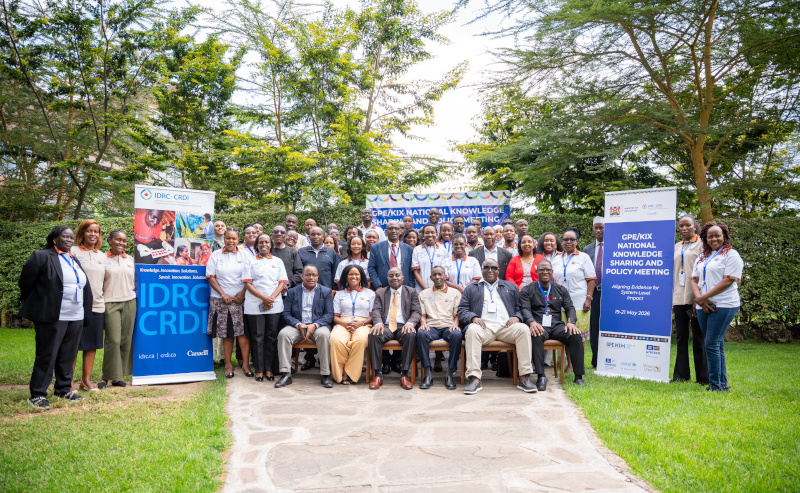
This was the central focus of the Global Partnership for Education’s Knowledge and Innovation Exchange (GPE KIX) National Knowledge Sharing and Policy Meeting, convened by the Kenya Ministry of Education, through the Kenya National Commission for UNESCO (KNATCOM), in partnership with GPE KIX Africa 19 Hub, a joint endeavor with Canada’s International Development Research Centre, from 19th - 21st May 2026 in Naivasha, Kenya.
Held under the theme “Aligning Evidence for System-Level Impact,” the three-day meeting brought together policymakers from Kenya and Somalia, researchers, GPE KIX project teams, development partners, and education stakeholders to examine what evidence exists, where gaps remain, and how research can be translated into practical education reforms.
Participants emphasized that the impact of evidence is not measured by the volume of studies produced, but by the quality, relevance, and usability of evidence for decision-making. They called for evidence that is timely, context-responsive, aligned with government priorities, and capable of improving the lives of learners and teachers.
Across the three days, discussions moved from evidence mapping to implementation planning. Day 1 focused on Kenya’s reform priorities, evidence needs, and existing work across the education sector. Day 2 provided space for researchers and project teams to present evidence on teacher professional development, foundational learning, gender and inclusion, wellbeing and resilience, data systems, and education innovation, while proposing ways this evidence could inform policy and implementation. Day 3 shifted toward action, with structured policy labs and roadmap discussions on what can be carried forward in a phased and coordinated manner.
The policy labs served as practical problem-solving spaces where policymakers, researchers, and partners examined priority challenges, available evidence, policy entry points, immediate actions, and medium-term implementation pathways.
Several key priorities emerged:
-
Teacher policy and workforce: Discussions highlighted teacher distribution imbalances, recruitment gaps, and the need for stronger teacher preparation, targeted incentives, and support for hard-to-staff areas.
-
Foundational learning: Participants noted persistent literacy and numeracy gaps, curriculum implementation challenges, and the need for intentional budgeting, quality assurance, stronger coordination, and better use of technology and data.
-
Gender, equity and inclusion: The discussions emphasized disability-friendly schools, gender-responsive pedagogy, early identification and assessment of special needs, and targeted support for vulnerable and marginalized learners.
-
Data systems and governance: Participants called for reduced fragmentation across education data systems, stronger interoperability, improved data quality assurance, and better links between data, planning, monitoring, and decision-making.
-
System resilience: Discussions underscored the need for teacher preparedness, climate-resilient infrastructure, community engagement, learning continuity systems, and stronger capacity to respond to disruptions.
These priorities were discussed alongside persistent barriers to evidence uptake, including fragmented initiatives, uneven implementation of existing policies, limited financing, weak coordination between national and county actors, and the need to translate research findings into clear and usable policy options.
Speaking on behalf of the African Union, Mr. Lukman Jaji, KIX Project Lead and Policy Offer at the African Union’s Pan-African Institute for Education for Development (AU-IPED), highlighted the importance of credible, timely, and actionable education data in strengthening education systems. He noted AU-IPED’s role under the GPE KIX Africa 19 Hub in supporting peer learning, knowledge exchange, and the use of continental tools such as the AU EMIS Norms and Standards to improve education data systems and decision-making.
Further contributions of GPE KIX Africa 19 Hub consortium partners were also central to the discussions. Mr. Polycarp Otieno, Education Specialist at UNICEF, underscored the importance of using evidence not only to confirm progress, but also to reveal gaps and guide more effective investment in learning, equity, and system strengthening. Dr. Victoria Kisaakye, Senior Project Coordinator at UNESCO IICBA, contributed to discussions on wellbeing, resilience, and teacher preparedness, reinforcing the need to connect evidence with the capacities of teachers, schools, and systems to respond to learner needs.
Somalia’s participation strengthened the regional and inter-country learning dimension of the meeting. The exchange created space for Somalia to reflect on Kenya’s experiences, share its own reform priorities, and identify lessons that can be contextualized to support evidence-informed policy, EMIS strengthening, knowledge translation, and national research capacity at home.
Ms. Joy Nafungo, Senior Programme Specialist at IDRC, emphasized that GPE KIX supports countries not only to generate evidence, but also to strengthen how evidence is used for policy uptake, system improvement, and scaling.
In the closing discussions, Dr. James Njogu, Ag. Secretary General at KNATCOM reaffirmed that evidence uptake requires sustained engagement beyond the workshop. The value of the meeting, he noted, will be seen in how the recommendations, policy lab outputs, and partnerships are carried forward into coordinated action.
The meeting concluded with agreement that the recommendations and policy lab outputs will inform a Kenya KIX evidence uptake roadmap, to be implemented in a phased manner by government, researchers, Hub partners, and education stakeholders.
-
Share:


